After talking to my dad the last few days, I realized that, while I've mentioned it to people, I haven't really documented my competitive background in the game in a place that's easy for my family (and RL friends) to find. Additionally, since I haven't had a blog since I left Microsoft, here's a new blog :-) So here's the "short" version of my Rock Band experience over the last 2 1/2 years, written so it can hopefully be understood by people who have spent a lot less time in the game than me :-)
My family knows well enough how I started with Rock Band - it was when my then brother-in-law Jason got it for Christmas while we were in Denver for the holidays. With a minimal amount of experience with GH3 on easy/medium the previous week, I started Rock Band on medium guitar, and in the couple days before the rest of the instruments were shipped in from Jason's parents in Utah, my sister Lisa and I finished the Rock Band guitar solo tour on medium, on hard except for two songs, and most of expert, not quite to the point where I was blocked yet.
It was probably almost two months before my wife and I were standing in Target looking at that massive box the game comes in and decided that we should just get it. The last songs on Hard guitar went down on the first try, and the last 5 songs on expert went down with a struggle, but what's probably more interesting is that I had a natural knack for expert vocals. Over time I started not just passing and 5-starring songs on vocals, but realizing that I could get 100% on quite a few songs, and get good scores on the leaderboards. This shouldn't have been much of a surprise, most of expert vocals is pitch control, which is something I already had. Some of it is reading the pitch lines, which is analogous to reading music, something that I also could already do. The rest is working around a partly broken video game engine, which is something I had to learn as I started to find songs that I couldn't play perfectly, not because I didn't know the songs or have the skill to do it, but because the spoken parts of the song relied on a speech-detection engine that frankly didn't work in a useful manner.
As I started getting into Rock Band, I kept running into a website called Scorehero, which caters to people who are good to the point of ridiculousness at music games like Guitar Hero and Rock Band. One of the nice things about scorehero is that people routinely share how they managed to achieve the things that they once thought impossible, and also how to get the highest possible scores on each song. People there spend lots of time looking over songs to find the best possible way to exploit Overdrive ("star power" in Guitar Hero) bonuses to maximize their score, and these overdrive plans (called "paths") are easy to find for the masses who are too lazy or lack the arithmetic aptitude to figure them out themselves. That's actually one of the ways that I started improving my scores on vocals. As I started getting good at vocals, I started wanting to find some people to start an online band with, since (with good reason) "full band" is the most prominent kind of team play on scorehero. Somewhere in the earlyish-middle part of 2008, I was already thinking I'd like to find a band to employ my RB vocals skills with. Finding the right band (in particular, a band with a reasonably high amount of skill composed of people who are ok with playing no earlier than about 10:00 PM pacific time) can be difficult, but I did find one person - an Ohio State music student I knew as BowlZ, who was at a similar rank (probably about 80th or so on the XBox Live leaderboards) and trajectory on drums to where I was on vocals. He loved that I had a strong musical background, and that he could talk about the music theory elements behind the game and expect me to understand what he was talking about. After our first attempt at a full band failed, we found a second pair of guitar/bass players for our band, which at this point consisted of top-25 players on every instrument, and was starting to look like the "super-bands" that people started forming quickly after the game's release. We called ourselves Barre Exam, played a bit, late at night, every week or so, pathing our overdrive on the fly, guided mostly by BowlZ's intuition on when we should all use overdrive.
After a little while, we started on my first Rock Band full band competition, when scorehero announced they would be running a bunch of leagues (something that scorehero does occasionally), including a full band league. We struggled to find times when all 4 of us could play consistently each week of the league, mostly because the bassist was moving for an internship at about that time, but we still got scores in each week. My Xbox stopped working during the first or second week, too. In spite of some logistical difficulties, we got first place on half of the regular-season songs (and second place on the other half). In fact, some of those difficulties may have helped us - while my Xbox was being fixed, I spent a lot of time programming against files extracted from the game, resulting in a program that spits out measure-by-measure scoring data for a song, which I started to use (along with Excel) to optimize our overdrive paths in later rounds. With that pathing process backing us, we got new high scores on all of the playoff songs, and ran away with the finals by hundreds of thousands of points.
After the league ended, we continued playing for awhile, finding that in general, the existing scores for most songs on the full band leaderboards on scorehero were pretty bad, compared to what was possible based on my spreadsheet paths, and so we got lots of firsts basically never were outside of the top 5 on any song after that point, but we never ranked that high overall, because we never got around to playing several of the songs. At some point, I started publishing that measure-by-measure score breakdown, along with an empty spreadsheet and instructions on how to path like I had. This was mostly so that I could have intelligent conversations with people about full band overdrive paths, since it's kind of lonely being the only one with a clue :-) Along with that data, I've since put up lots of other data on that website, such as calculated optimal overdrive paths for drums, score thresholds for getting any number of "stars" on a song, pitches and lyrics for vocalists, and a searchable database of stats and metadata about the songs. Basically all of the content on there is computer-generated.
When Rock Band 2 came out (or a little later, when scorehero announced that leagues were starting again), BowlZ and I started looking for new guitar and bass players for a new Rock Band 2 band. At this point, our reputation as being hyper-competitive with our bands preceded us, and we found some amazingly skilled players for our band. On guitar, we had a High School student from somewhere near Sacramento, whose left hand is featured in this amazing video. On bass, we had someone who had done 100% runs on bass on virtually every song in the game, as well about 90% of the songs on guitar. We called the band "Better Than You --v", where the "--v" is meant to be an arrow pointing to the band immediately below us on the leaderboards (I thought that making such a statement would be especially funny if we only outscored the beand below us by a miniscule amount). Here's a picture of our characters we used when we played together. From left to right, blob (bass), BowlZ (drums), me (vocals) and chidori (guitar).
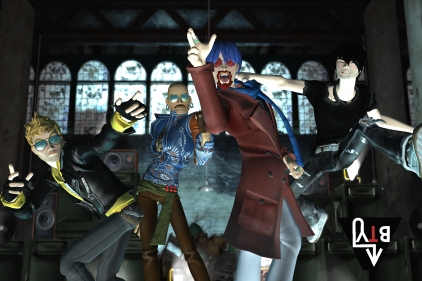
We proceeded to win our second full band league, and then slowly but surely play through the rest of the 84 songs in Rock Band 2, until we finally retired with first place on over 2/3 of the songs in the game, and a total score of 151 million points - 3.5 million above the previous top band and 6.5 million above the previous top band on Xbox 360.
After Better Than You--v retired, BowlZ and I assembled one more band, but with me on bass instead of vocals this time, for the "DLC Whores Rivalry", a friendly 9-week full band competition that focused on selecting songs from Rock Band's vast selection of downloadable content (DLC). We won that as well, under the name "Them Again", with top scores on 12 of the 18 songs used.
I've also done some Rock Band competitions with local people, without the advantage of being able to find highly competitive players online to play with. The first was for an internal charity event at Microsoft, where most of the competition was based on judged style/performance aspects and audience votes (where more votes could be bought with donations to certain charities). In the face of no real sure things, we played a crowd favorite, More Than A Feeling by Boston. I was on both guitar and vocals, friend-of-a-friend Dave Manning was on drums, and co-worker Bryan Reich was on bass. Our second-place finish got us each extra copies of Rock Band 2, I gave my copy to my sister, whose in-laws were indirectly responsible for me playing these games to begin with. The next week, there was another similar contest at Microsoft, and we won copies of Guitar Hero: World Tour from that.
After leaving Microsoft and starting at Google, I found another Rock Band competition with my new employer, thankfully based on in-game score again. I found the best players I knew of and we played the 6 total contest songs across 2 rounds of play, and got first place on 5 of them and won the gold medals by a pretty good margin.
And now, we finally get the current event - The contest I'm competing in is the Total Rock, Total Rewards contest, sponsored by Harrah's casinos and enabled by Harmonix's Rock Band Bar Nights program. The hard part about these sorts of contests is finding a good band who's not just online. In this case, I also had to find a band that's all over 21.
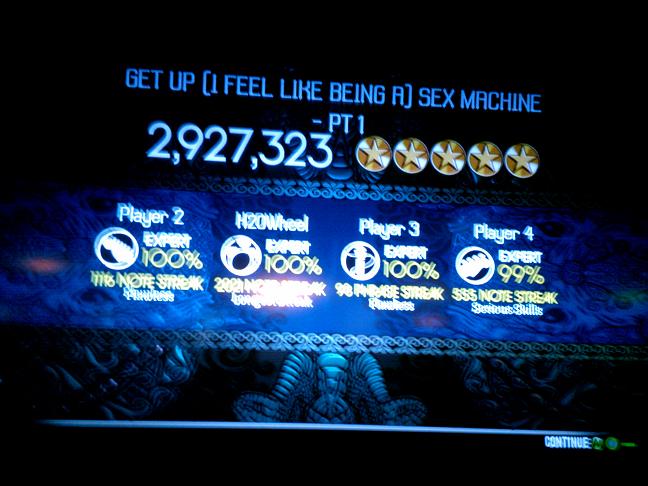
In order to qualify for it, I had to find a band (in which all members had to be over 21 and otherwise able to compete at the local qualification venue, a bar in Seattle), and we had to get the highest score in Seattle on any of a preselected group of around 30 songs. The Seattle qualifier ran every Wednesday night for about a month, and each band registered there could take one try to get that highest score every week. One song quickly became the obvious strategic choice for serious bands in any of the competitive venues (like Seattle), the song was called "Get Up (I Feel Like Being a) Sex Machine, Pt. 1" by James Brown, and it's pretty much about as ridiculous as it sounds. As the winners of that qualifier, we're representing Seattle (and, indeed, the whole Pacific Northwest) in up to two more rounds of competition at Bally's Atlantic City on July 1-2. The difference in the Atlantic City rounds is that they are no longer all about score - they are scored mostly subjectively and include performance and style aspects as well as in-game scoring aspects.
We competed in Seattle at the Waterwheel Lounge, you can see the leaderboard from the Seattle qualifier if it interests you. We competed as the Last Minute Rejects. The leaderboard shows a lot of scores by just a few bands, but what it doesn't show you is where those scores came from across time. I'll attempt to chronicle that, if I remember correctly how things went (and maybe I can get Nick from No Boston After Midnight to confirm).
The first week of the qualifiers, the first band competed:
| No Boston After Midnight | 2231692 on Get Up | For a day or two this was the top score in the contest, they even got an interview with the organizers). |
The second week, I wasn't there, but I don't think anyone played, anyways.
The third week, some members of No Boston After Midnight were around to watch, while two other bands competed:
| Suckerpunch | 1629627 on Highway Star | |
| Schkaten Heim | 2240223 on Get Up | First so far by less than 9000 points |
The fourth week was where we came in, and it was a busy one:
| The Brock Sampsons | 2241190 on Get Up | Pushing the numbers up slowly |
| Schkaten Heim | 2341270 on Get Up | Taking the lead again |
| The Last Minute Rejects | 2200695 on Panic Switch | |
| No Boston After Midnight | 2552884 on Get Up |
After seeing 2.55 million from NBAM, we realized we were going to have to learn Get Up for the fifth and final week, and the top two bands in previous weeks also geared up to bring up the level of competition for that last week:
| The Last Minute Rejects | 2927323 on Get Up | Highest score in any qualifier in the country, 100% on vocals, guitar and drums |
| Schkaten Heim | 2714129 on Get Up | A great score and a great improvement, but it was clear that us going first affected the mood of other bands |
| No Boston After Midnight | 2653355 on Get Up | All the while giving us the evil eye for stealing their trip to Atlantic City... |
Nick, the drummer for No Boston After Midnight, had been unofficially updating a combined leaderboard for all of the qualifier sites as they had progressed, and after the competitive part of the night was over, he posted up all of our scores, and added "Thus the first law of Scorehero full band play is maintained: If there is a full band competition, Kawigi's band will have the highest score."
So the next event is up to two rounds of competition in Atlantic City, with the other 17 qualifying bands from all over the country (and the one from Canada :-) ) on July 1-2. We will play one song of our choice and be graded subjectively on our skill at the game, our style and our performance. I'll be a little out of my element just because I can't rely on numbers. Then if we are one of the top 4 teams in that round, we play one random song followed by one song of our choice, and are again judged on style and performance, with 1/3 of our score based on our in-game score as a percentage of the top leaderboard score for those songs. Any suggestions on how we make it happen?

This comment has been removed by a blog administrator.
ReplyDelete"Thus the first law of Scorehero full band play is maintained: If there is a full band competition, Kawigi's band will have the highest score."
ReplyDeleteHaha!